
We may earn money or products from the companies mentioned in this post.
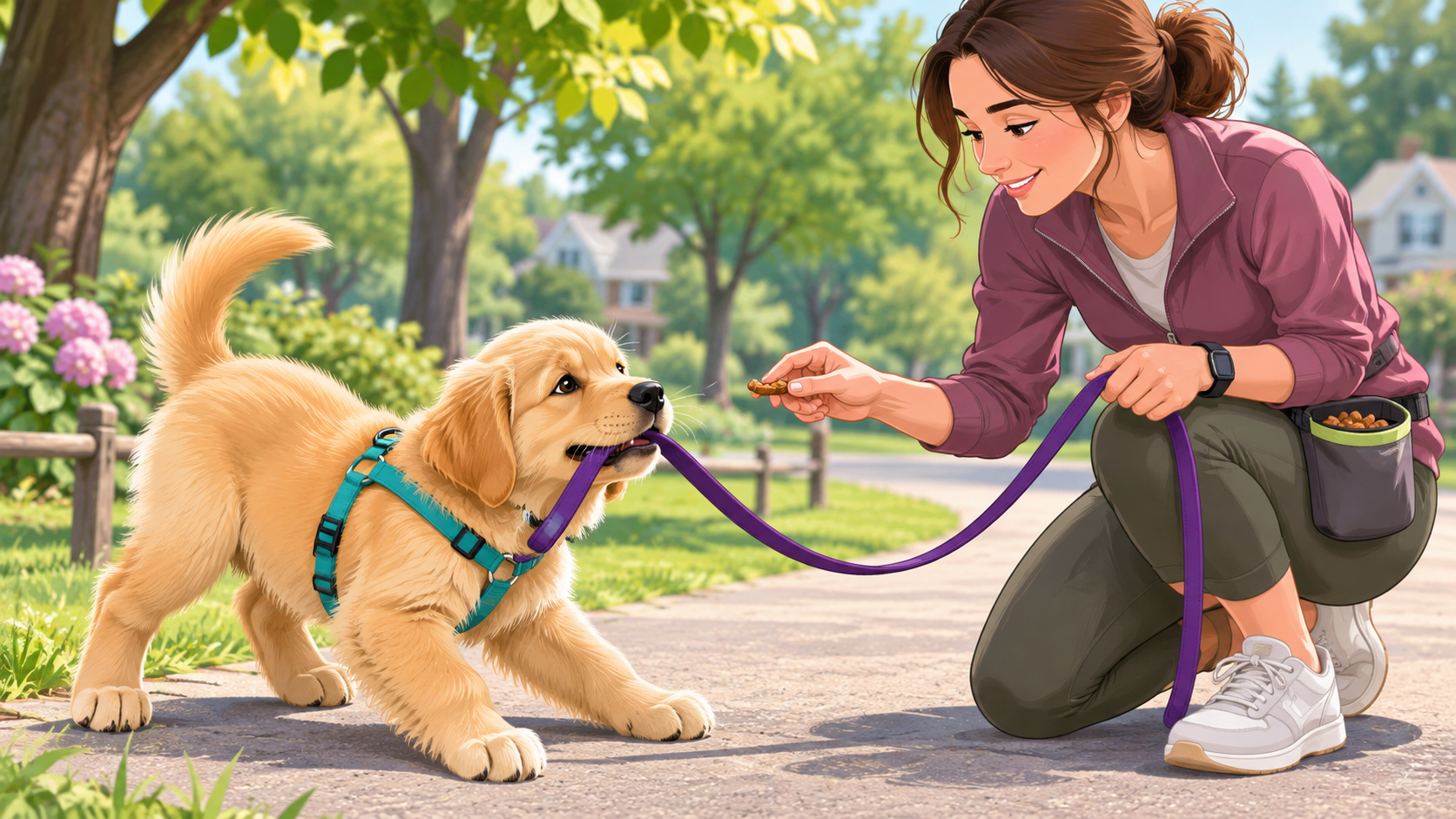
How to Stop a Puppy From Biting the Leash on Walks
Your puppy grabs the leash, you pull back, and suddenly the walk is a tug-of-war. It’s a frustrating cycle, but calm, consistent practice works better than force.
This guide gives you a plan for your next walk. It covers what to do mid-grab, how to spot the likely cause, and how to handle a puppy who keeps regrabbing. It also covers what a harness can and can’t do, plus when to call a professional.
Our research draws on guidance from the American Kennel Club, Dogs Trust, and the Maryland SPCA. It also draws on the American Veterinary Society of Animal Behavior (AVSAB). Our early verdict is that training solves more of this problem than new gear does.
What to do the moment your puppy grabs the leash
Stop walking, keep the leash still, and don’t pull back. Wait for your puppy to let go, or calmly trade the leash for a treat or toy. Reward the release, then take a few easy steps forward.
Why your puppy bites the leash: five common patterns
Leash grabbing alone doesn’t tell you the cause, and it doesn’t mean your puppy is stubborn, dominant, or aggressive. Watch when it happens, and you’ll usually spot one of these patterns:
- Play: A moving leash looks like a toy, and tugging back feels like a fun game.
- Frustration: Your puppy wants to reach a smell, person, or dog and can’t.
- Overstimulation: Busy streets, traffic, or other dogs can tip a puppy into grabbing.
- Tiredness: Overtired puppies often get mouthier, much like a cranky toddler.
- Discomfort: Poorly fitted gear or pain can show up as biting at the leash.
The pattern guides your fix. A playful puppy needs a better outlet, while a tired puppy needs a shorter walk.
A five-step plan for your next walk
- Prepare rewards before you leave. Pack small, soft treats your puppy loves. Bring a toy they like to carry, and check that the harness fits comfortably.
- Reduce leash movement. Hold the leash close to your body with a little slack. A swinging, dangling leash invites play.
- Interrupt calmly. If your puppy grabs, stop and become boring. Don’t tug, scold, or wave the leash around.
- Reward an alternative. Pay your puppy for letting go, looking up at you, or carrying a toy instead. A “drop it” or release cue helps here, but teach it at home first.
- Resume with easy steps. Walk a few steps and reward while the leash stays slack. Short wins build the habit you want.
Reward timing matters most. Give most treats while your puppy walks calmly, not only after a grab, so relaxed walking is what pays off.
What to do when your puppy keeps regrabbing the leash
If your puppy grabs again within seconds, the outing is probably too hard right now. Make it easier instead of repeating the same struggle.
- Shorten the walk. Several short outings can go better than one long one.
- Pick quieter places. Practice in your home, yard, or a calm street before busy areas.
- Raise the difficulty slowly. Add distractions only after your puppy succeeds at the easier level.
- End before a meltdown. If your puppy seems tired, head home. More exercise isn’t automatically the answer.
Low-distraction practice is where real progress happens. Once your puppy stays calm indoors, you can also practice walking beside you without pulling. For now, aim for relaxed loose-leash walking rather than a strict heel.
Every puppy learns at its own pace, so there’s no fixed timeline. Steady, small improvements are the sign you’re on track.
Can a harness or toy stop leash biting?
Gear can make the leash harder to grab, but it won’t teach your puppy to walk nicely. A back-clip harness places the leash behind the shoulders, which keeps it out of reach for some dogs. A favorite toy to carry can also keep a busy mouth occupied.
If your current harness fits well, you don’t need to buy anything. Use what you have and focus on the training plan.
If you do want new gear, Dog Friendly Co. sells a Personalised Dog Harness. It has adjustable straps, a one-click buckle, a grab handle, and a back leash attachment. A front D-ring costs an extra $12.
When we checked on November 18, 2026, the site displayed $36 for the harness with $47 crossed out. Its Rope Dog Leash displayed $33, also marked down from $47. Neither page stated a currency code, so confirm the final price, shipping, and tax at checkout.
The rope leash comes in small and regular sizes with a padded handle. We found no chew-proof claim, so don’t expect it to survive a determined puppy.
Read the policies before you order. Returns must be unwashed and in original condition within 60 days of delivery. Personalized patches are excluded.
The warranty wording also conflicts. Marketing mentions lifetime coverage, but the returns page lists a 30-day claim window and excludes normal wear. Ask the company in writing what’s covered before you rely on it.
Front-clip harnesses mainly target pulling, not biting. If you’re weighing one, our PetSafe Easy Walk harness review covers that style. PetSafe describes a tightening martingale design, so it isn’t a leash-biting fix.
Mistakes that turn leash biting into a bigger game
- Tugging back: Pulling turns the leash into a rope toy and makes grabbing more fun.
- Leash jerks or corrections: AVSAB supports reward-based training and opposes leash corrections and other harsh methods.
- Scolding: Telling a puppy off can add excitement or stress, which may lead to more grabbing.
When to call a vet or a reward-based trainer
See your veterinarian if biting starts suddenly or gets worse. Pain or illness can show up as new mouthy behavior.
Contact a qualified, reward-based trainer if your puppy’s biting feels unsafe or progress stalls. That includes hard bites to your hands or clothing, or grabbing that keeps you from walking at all.
Common questions about puppy leash biting
Am I rewarding biting by giving treats?
Not if you reward the right moments. Give most treats for calm walking and for letting go, not for the grab itself.
Will my puppy grow out of leash biting?
Some puppies improve as they mature, but no age guarantees it. Practice speeds things up, and tug-of-war habits can stick around, so start the plan now.
Is buying a harness enough to fix it?
No. A harness only changes where the leash sits, and your puppy still needs rewards for calm, slack-leash walking.
Is training or new gear the better fix for leash biting?
Training is the better fix for almost every puppy owner. It changes the habit itself, while gear only changes access to the leash. Patience is the main limit.
Gear can help, but it won’t cure leash biting. A back-clip harness you already own works fine. If you shop for a new one, confirm the return and warranty terms first.